Pakistan’s economy has remained one of the country’s most discussed topics over the past few years. Rising inflation, currency fluctuations, IMF agreements, and changing business conditions have directly affected households, businesses, and investors.
While the country has faced significant economic challenges, there are also signs of gradual improvement in some key areas. Understanding these developments can help individuals, businesses, and investors make better financial decisions.
In this article, we’ll explain Pakistan’s latest economic situation in simple language, covering inflation, GDP growth, exports, the stock market, foreign exchange reserves, and what the future may hold.
1. Economic Growth (GDP)
Gross Domestic Product (GDP) measures the total value of goods and services produced within a country.
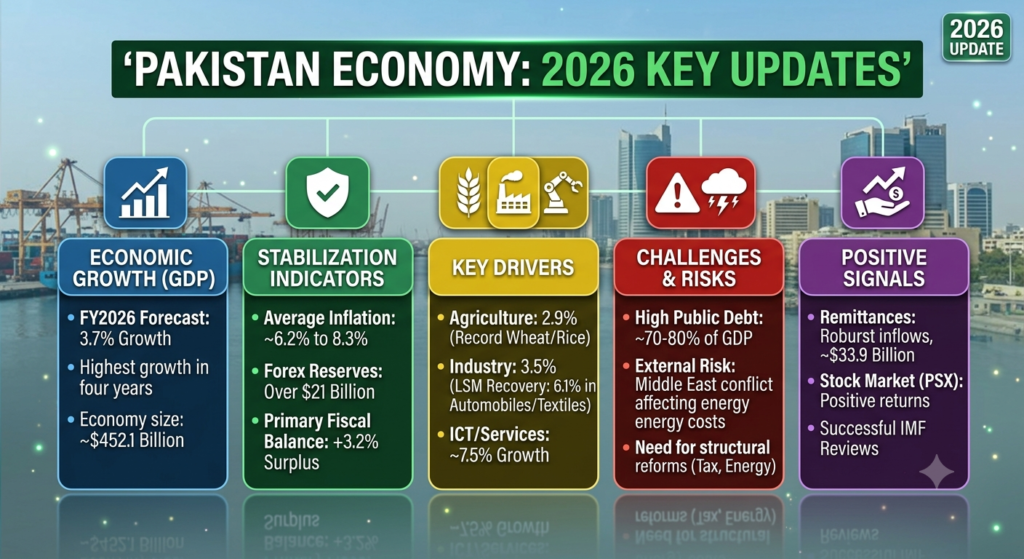
Pakistan’s economy has shown signs of recovery after a difficult period. Growth has been supported by improvements in agriculture, selected industrial sectors, and services. However, economic expansion remains slower than many developing countries due to high borrowing costs, energy challenges, and fiscal pressures.
Sustained economic growth will depend on structural reforms, investment, and improved productivity.
2. Inflation and Cost of Living
Inflation has been one of the biggest concerns for Pakistani families.
Higher prices for food, electricity, fuel, transportation, and household goods have increased the cost of living significantly. Although inflation has eased compared with its recent peak, many families continue to feel financial pressure.
Lower inflation helps improve purchasing power, but stable prices over a longer period are necessary before consumers experience meaningful relief.
3. Pakistani Rupee (PKR)
The value of the Pakistani Rupee plays a crucial role in the economy.
A stronger rupee can reduce import costs, while a weaker rupee makes imported products such as fuel, electronics, and machinery more expensive.
Exchange rate stability helps businesses plan better, attracts investment, and improves overall economic confidence.
4. Pakistan Stock Exchange (PSX)
The Pakistan Stock Exchange continues to attract attention from long-term investors.
Many investors believe quality companies can provide attractive long-term returns despite short-term market volatility. Banking, fertilizer, technology, cement, and energy sectors often receive strong investor interest.
Experts generally recommend long-term investing rather than attempting to predict short-term market movements.
5. Exports and Imports
Exports are essential because they bring foreign currency into Pakistan.
Major export industries include:
- Textiles and garments
- Rice
- Surgical instruments
- Sports goods
- Information technology services
Increasing exports while reducing unnecessary imports can improve Pakistan’s trade balance and strengthen foreign exchange reserves.
6. Foreign Exchange Reserves
Foreign exchange reserves help a country pay for imports, manage external debt obligations, and support currency stability.
Healthy reserves increase investor confidence and reduce financial risks during periods of global uncertainty.
Maintaining adequate reserves remains an important objective for economic policymakers.
7. IMF Program and Economic Reforms
Pakistan has worked with the International Monetary Fund (IMF) to stabilize the economy.
These programs usually focus on:
- Improving tax collection
- Reducing fiscal deficits
- Reforming the energy sector
- Strengthening public finances
- Encouraging economic reforms
While such measures can be challenging in the short term, they aim to improve long-term economic stability.
8. Employment and Business Opportunities
Pakistan’s growing digital economy has created new opportunities.
Promising sectors include:
- Information Technology (IT)
- Freelancing
- E-commerce
- Digital Marketing
- Artificial Intelligence (AI)
- Renewable Energy
- Financial Technology (FinTech)
Young professionals with digital skills are increasingly finding opportunities both locally and internationally.
9. Challenges Facing Pakistan’s Economy
Despite positive developments, several challenges remain:
- High public debt
- Energy shortages and costs
- Tax collection issues
- Inflationary pressures
- Climate-related risks
- Unemployment
- Slow industrial growth
Addressing these issues will require consistent policy implementation and long-term planning.
10. What Does the Future Look Like?
Pakistan’s economic outlook will depend on continued reforms, political stability, stronger exports, private investment, and responsible fiscal management.
If inflation remains under control, exports continue to grow, and investment improves, the economy could strengthen further over the coming years.
However, global economic conditions, commodity prices, and domestic policy decisions will continue to influence the country’s progress.
Final Thoughts
Pakistan’s economy is gradually moving through a period of adjustment and recovery. While challenges such as inflation, debt, and energy costs remain, there are also encouraging signs in exports, technology, entrepreneurship, and investment.
For individuals, the best approach is to stay informed, improve financial planning, develop in-demand skills, and make investment decisions based on careful research rather than short-term market sentiment.
A stronger economy benefits everyone—from households and small businesses to investors and future generations.